



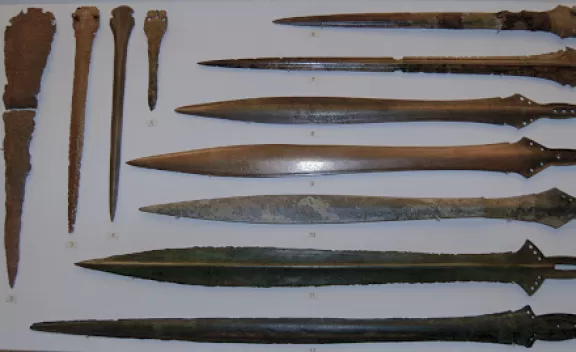
The Isleham Hoard is a remarkable collection consisting of over 6,500 pieces of worked and unworked bronze artifacts, all dating from the Bronze Age. This exceptional hoard was discovered in 1959 by "Bill" William Houghton and his brother Arthur, at Isleham, near Ely, in Cambridgeshire, England.
Notably, the Isleham Hoard stands as the largest Bronze Age treasure ever unearthed in England and is considered one of the most exceptional discoveries of its kind. It comprises a wide range of items, including swords, knight's helmets, arrows, axes, palstaves (a type of axe), knives, daggers, armor, decorative equipment (particularly for horses), and numerous fragments of sheet bronze. All of these artifacts are dated to the Wilburton-Wallington phases of the Late Bronze Age, approximately around 1000 BC. The swords found in the hoard exhibit holes that would have held rivets or studs to secure the wooden hilt in place.
Many of these objects have been donated to the St Edmundsbury City Council Heritage Service. Some are displayed at the Anglo-Saxon village of West Stow, located outside Bury St Edmunds, while others are preserved and can be found at the University of Cambridge Museum of Archaeology and Anthropology in Cambridge. This extraordinary hoard provides valuable insights into the material culture and craftsmanship of the Bronze Age inhabitants of the region, offering a window into their technology, weaponry, and artistic expressions.